


Create intuitive, premium and conversion-focused mobile app experiences for Dubai businesses with us 05 Oct 2026
Mobile App UI/UX Design Dubai for High-Converting Business Applications

Writen by Admin
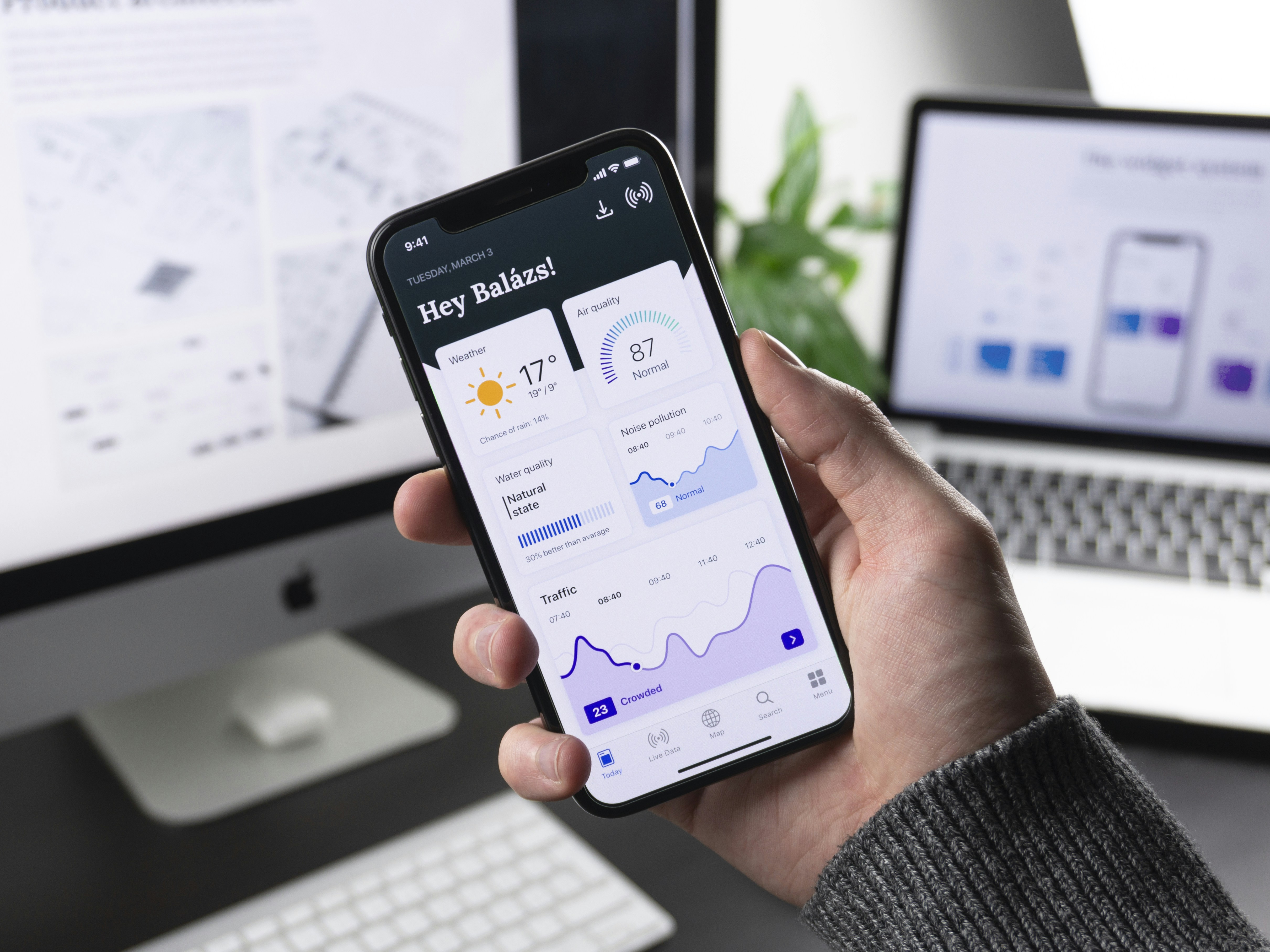
Mobile App UI/UX Design Dubai for High-Converting Business Applications
A mobile application can have powerful technology behind it and still fail to generate business results if users find it confusing, slow or difficult to navigate. For businesses investing in mobile app UI/UX design in Dubai, the interface is not simply a visual layer. It influences how customers understand the product, trust the business, complete transactions and return to the application.
Dubai's digital market has created increasingly high expectations for mobile experiences. Users regularly interact with ecommerce, banking, mobility, government, food delivery, hospitality and business applications, making speed, clarity, personalization and convenience important parts of the digital experience. Recent 2026 UI/UX research and industry reporting also emphasizes intuitive navigation, performance, personalization, accessibility and bilingual experiences as important considerations for UAE mobile applications. :contentReference[oaicite:0]{index=0}
Professional mobile app UI/UX design services in Dubai combine business strategy, user research, information architecture, interaction design, visual design, prototyping and usability testing to create applications that are easier to understand and more effective at driving actions.
What Is Mobile App UI/UX Design?
UI and UX are related but different disciplines.
UX design focuses on how users move through an application, understand information and complete tasks. It includes research, user journeys, information architecture, wireframes, interaction patterns and usability.
UI design focuses on the visual interface users interact with, including typography, colors, buttons, icons, cards, forms, spacing, imagery and visual hierarchy.
When combined properly, UI and UX design create a product that looks professional while also making important actions easy to discover and complete.
Why UI/UX Matters for Dubai Business Applications
Users rarely evaluate an app based on its technology stack. They experience the product through screens, navigation, response times, forms, search, checkout and feedback.
A strong mobile app UX can help businesses:
- Increase user engagement
- Improve registration completion
- Increase purchases and bookings
- Reduce onboarding abandonment
- Improve customer retention
- Reduce support requests
- Build trust
- Improve brand perception
- Make complex processes easier
For a business application, every unnecessary step can create friction. Effective UX design identifies those points before development begins.
Conversion-Focused Mobile App UX Design
High-converting mobile apps are designed around specific business outcomes rather than simply creating attractive screens.
Depending on the application, the primary conversion could be:
- Creating an account
- Making a purchase
- Booking an appointment
- Requesting a quotation
- Submitting an application
- Making a payment
- Scheduling a service
- Starting a subscription
- Contacting a sales representative
- Renewing a membership
UX designers map the path toward these actions and remove unnecessary friction while maintaining appropriate trust and information requirements.
Mobile App UX Research Dubai
Good UI design starts with understanding users. UX research helps identify what customers need, where they struggle and why they abandon particular processes.
Research activities may include:
- User interviews
- Customer surveys
- Competitor analysis
- App reviews analysis
- Analytics review
- Customer support analysis
- User journey mapping
- Usability testing
For established applications, existing analytics and customer feedback can reveal high-value UX improvements. For new products, research can help validate assumptions before significant development investment.
User Personas and Customer Journeys
Different users can have different objectives even when they use the same application.
A business app may have:
- Customers
- Managers
- Employees
- Sales representatives
- Service providers
- Administrators
- Partners
Creating user personas and journey maps helps designers understand what each group needs and prevents the interface from becoming overloaded with irrelevant functionality.
Information Architecture for Mobile Applications
Information architecture determines how content and functionality are organized within the app.
A strong information architecture answers questions such as:
- Where should users find a particular feature?
- What should appear on the home screen?
- Which actions deserve primary navigation?
- What information should be grouped together?
- What should be accessible with one tap?
- What can remain deeper in the interface?
Good architecture reduces cognitive effort and helps users develop predictable navigation habits.
Mobile App Wireframing
Wireframes provide an early representation of the application before detailed visual design begins. They allow product teams to validate layout, hierarchy and functionality without spending unnecessary time on polished visual assets.
Wireframes can cover:
- Onboarding
- Login
- Home
- Search
- Product or service pages
- Booking flows
- Checkout
- Payments
- Profile
- Notifications
- Settings
Testing the structure early can reduce expensive redesign work during development.
Interactive Mobile App Prototypes
Interactive prototypes allow stakeholders and test users to experience the planned navigation before engineering starts.
A prototype can demonstrate:
- Screen transitions
- Navigation
- Forms
- Buttons
- Search
- Checkout
- Booking workflows
- Error states
- Success states
- Animations
Clickable prototypes are particularly useful for business applications because decision-makers can review a realistic experience before development resources are committed.
Modern Mobile UI Design Dubai
Modern UI design should balance visual appeal with clarity and usability. Current 2026 design discussions increasingly focus on reducing cognitive effort, creating predictable interactions, personalization and performance rather than simply adding visual effects. :contentReference[oaicite:1]{index=1}
A strong interface typically includes:
- Clear visual hierarchy
- Consistent spacing
- Readable typography
- Strong contrast
- Recognizable icons
- Consistent buttons
- Purposeful animation
- Useful feedback states
- Accessible touch targets
The goal is not to make every screen visually complex. It is to make important information and actions easy to understand.
Design Systems for Mobile Applications
A design system creates reusable rules and components that keep the application visually and behaviorally consistent.
A mobile design system may include:
- Color tokens
- Typography
- Buttons
- Input fields
- Cards
- Navigation
- Icons
- Modal components
- Alerts
- Tables
- Tabs
- Loading states
- Error states
- Empty states
Design systems become increasingly valuable as an app grows because new features can be designed using established components rather than reinventing the interface each time.
Arabic and English Mobile App UI/UX Design
Dubai businesses often serve both Arabic-speaking and English-speaking users. Bilingual design should therefore be considered at the beginning of the project rather than added after the English interface has been completed.
Arabic UX requires thoughtful support for:
- Right-to-left layouts
- Arabic typography
- Mirrored navigation
- Text expansion and contraction
- Arabic form fields
- Bilingual content
- Localized dates and numbers
- Mixed Arabic-English content
Designing RTL correctly requires more than switching text alignment. The interface structure, navigation patterns, icons and interaction logic may also need to adapt. UAE UI/UX guidance increasingly treats bilingual and RTL design as a foundational consideration rather than a last-minute localization task. :contentReference[oaicite:2]{index=2}
Mobile UX for Ecommerce Applications
Ecommerce apps need to move customers efficiently from discovery to purchase. A visually attractive interface is not enough if users struggle to search, compare products or complete checkout.
Ecommerce UI/UX can optimize:
- Product discovery
- Search
- Filters
- Product images
- Product information
- Reviews
- Wishlist
- Cart
- Checkout
- Payment
- Order tracking
Personalized recommendations and intelligent search can further improve product discovery when implemented using reliable product and customer data.
UI/UX Design for Fintech and Banking Apps
Fintech applications require especially strong UX because users need confidence when interacting with financial information and transactions.
Important design considerations include:
- Clear account information
- Transaction confirmation
- Secure authentication
- Biometric login
- Transparent fees
- Clear error messages
- Payment status
- Fraud warnings
- Accessible financial information
In financial products, trust and clarity should take priority over decorative interface elements.
Healthcare Mobile App UI/UX
Healthcare applications need to make important information easy to understand while maintaining appropriate privacy and accessibility.
Healthcare UX can cover:
- Appointment booking
- Doctor discovery
- Patient profiles
- Medical information
- Prescription information
- Telemedicine
- Notifications
- Payments
Design decisions should reduce confusion and make important actions clearly distinguishable.
Real Estate App UI/UX Design Dubai
Real estate applications often involve large amounts of information. Effective UX can make property discovery easier by organizing listings, filters, maps and property details logically.
Useful features include:
- Property search
- Advanced filters
- Map-based discovery
- Image galleries
- Video tours
- Virtual tours
- Mortgage calculators
- Property comparison
- Agent contact
- Viewing bookings
Hospitality and Travel App UX
Dubai's hospitality and tourism businesses require mobile experiences that can handle discovery, booking, payment and post-booking engagement.
UX can optimize:
- Hotel discovery
- Room selection
- Restaurant reservations
- Activity booking
- Travel itineraries
- Digital check-in
- Offers
- Loyalty
- Location services
The experience should remain simple even when the underlying business workflow is complex.
Business and Enterprise Mobile App UX
Not every mobile app is customer-facing. Businesses increasingly use mobile applications for employees, sales teams, field service, logistics, operations and management.
Enterprise mobile UX may include:
- Employee dashboards
- Task management
- Field service workflows
- Sales CRM
- Inventory
- Approvals
- Reports
- Notifications
- Document management
- Business analytics
Enterprise applications should prioritize efficiency, reducing the number of steps required to complete repetitive tasks.
AI-Powered Mobile App UX
AI is changing how users interact with business applications. Instead of navigating every function manually, users can increasingly describe what they want and allow intelligent interfaces to assist them.
AI UX patterns can include:
- AI shopping assistants
- Natural-language search
- Personalized recommendations
- Predictive suggestions
- AI-generated summaries
- Conversational interfaces
- Smart notifications
- Automated form assistance
However, AI should be introduced where it simplifies the user's task. Adding an AI feature simply because it is technically possible can make an application more complicated rather than more useful.
Personalization in Mobile App UX
Personalization can make applications more relevant by adapting content or recommendations based on legitimate user signals.
Examples include:
- Recently viewed products
- Recommended services
- Preferred locations
- Saved searches
- Personalized offers
- Relevant notifications
- Frequently used actions
Personalization should remain transparent and respect user preferences and applicable privacy requirements.
Microinteractions and Mobile App Engagement
Microinteractions provide feedback when users perform actions. Examples include button states, loading indicators, confirmation messages, progress indicators and subtle transitions.
Good microinteractions can help users understand:
- Whether an action worked
- Whether information is loading
- Whether a payment succeeded
- Whether a form contains an error
- What happens next
Animation should support usability rather than slow down the experience. Current UAE UI/UX guidance also emphasizes purposeful micro-interactions and performance rather than decorative effects alone. :contentReference[oaicite:3]{index=3}
Accessibility-Focused Mobile App Design
Accessible design helps more users navigate an application comfortably and can improve usability for everyone.
Accessibility considerations include:
- Readable text
- Strong contrast
- Appropriate touch targets
- Screen-reader support
- Meaningful labels
- Clear error messages
- Non-color-only status indicators
- Accessible forms
Accessibility should be incorporated into the design system rather than treated as a final testing step.
Mobile App Performance and UX
Performance is part of UX. A beautiful application that takes too long to load can still create a poor experience.
Design teams should consider:
- Loading states
- Skeleton screens
- Image optimization
- Progressive content loading
- Offline states
- Error recovery
- Slow network conditions
Designing for real-world conditions helps the interface remain useful even when network performance varies.
UX Testing for Dubai Mobile Applications
Usability testing helps determine whether users can complete important tasks without assistance.
Testing can evaluate:
- Onboarding
- Navigation
- Search
- Forms
- Checkout
- Booking
- Payments
- Account management
- Customer support
Testing with representative UAE users can also identify cultural, language and localization issues that may not be obvious to the product team.
A/B Testing and Conversion Optimization
Once an application is launched, design can continue to improve through analytics and controlled experiments.
A/B testing can compare:
- Onboarding flows
- CTA placement
- Checkout steps
- Product layouts
- Pricing presentation
- Navigation structures
- Promotional messages
Design decisions should ultimately be connected to measurable business outcomes rather than subjective preferences.
Mobile App UI/UX Design Process in Dubai
1. Business Discovery
The process begins with understanding the business model, target users, competitors, objectives and technical constraints.
2. User Research
Research identifies user needs, pain points, expectations and behavioral patterns.
3. User Journeys
Key journeys are mapped from entry point to successful completion.
4. Information Architecture
Features and content are organized into an intuitive structure.
5. Wireframes
Low-fidelity layouts establish the structure before detailed UI design.
6. Visual UI Design
Typography, color, components, imagery and interaction states are developed into a consistent design system.
7. Interactive Prototype
Important flows are connected into a realistic clickable prototype.
8. Usability Testing
Representative users test important tasks and provide feedback.
9. Developer Handoff
Design specifications, components and assets are prepared for engineering.
10. Post-Launch Optimization
Analytics, user feedback and conversion data are used to continuously improve the application.
UI/UX Design Handoff to Mobile App Developers
A professional UI/UX process should make implementation easier for developers. Handoff should include component specifications, spacing rules, typography, colors, states, interactions and responsive behavior.
When design and engineering teams collaborate early, technical limitations can be considered before the final interface is approved.
Mobile App UI/UX Design for iOS and Android
iOS and Android users expect familiar platform behaviors. A cross-platform design system can maintain brand consistency while respecting important platform conventions.
Depending on the product, the development team may use:
- Swift for native iOS
- Kotlin for native Android
- Flutter for cross-platform apps
- React Native for cross-platform applications
The UI/UX design should be created with the selected development architecture in mind.
Mobile App Redesign Services Dubai
Businesses do not always need a completely new application. Sometimes the existing product contains valuable functionality but suffers from outdated navigation, inconsistent UI or poor conversion performance.
An app redesign can focus on:
- UX audit
- Navigation improvements
- Visual modernization
- Design system creation
- Onboarding optimization
- Checkout optimization
- Accessibility
- Arabic RTL support
- Performance-focused interface improvements
Redesign projects should preserve useful business functionality while improving the experience around it.
Mobile App UI/UX Design Cost in Dubai
UI/UX design pricing depends on the complexity of the product rather than simply the number of screens.
Key factors include:
- Number of user types
- Number of screens
- UX research depth
- Prototype complexity
- Design system requirements
- Arabic RTL support
- Animation and interaction design
- Usability testing
- Existing app redesign requirements
- Enterprise integrations
Published Dubai market estimates in 2026 show a wide range for professional mobile UI/UX projects, with complexity, screen count, research and bilingual requirements significantly influencing the final scope. These figures should be treated as indicative planning ranges rather than fixed market prices. :contentReference[oaicite:4]{index=4}
How to Choose a Mobile App UI/UX Design Company in Dubai
Choosing a UI/UX partner should involve more than reviewing attractive portfolio screenshots.
Evaluate whether the design company can demonstrate:
- User research capability
- UX strategy
- Information architecture
- Wireframing
- Interactive prototypes
- Design systems
- Usability testing
- Arabic RTL expertise
- Mobile product experience
- Developer collaboration
- Conversion optimization
- Post-launch product improvement
A strong portfolio should also demonstrate measurable business thinking rather than only visual design.
Why nDigital.me for Mobile App UI/UX Design Dubai?
nDigital.me combines UI/UX design with mobile application development, AI, custom software and digital transformation services. This allows the design process to remain connected to the technology and business requirements of the final product.
Mobile app UI/UX services can include:
- UX strategy
- User research
- User journey mapping
- Information architecture
- Wireframing
- Interactive prototypes
- Mobile UI design
- Design systems
- Arabic RTL design
- iOS and Android design
- Usability testing
- App redesign
- AI-powered UX
- Conversion optimization
- Developer handoff
Whether the requirement is an ecommerce app, fintech platform, healthcare application, real estate product, sports platform, SaaS application or enterprise business tool, the objective is to create an experience that makes important actions easier while supporting measurable business goals.
Frequently Asked Questions
What is mobile app UI/UX design?
Mobile app UI/UX design combines user experience strategy and visual interface design to create applications that are intuitive, usable, accessible and aligned with business objectives.
Why is UI/UX important for mobile apps?
Good UI/UX reduces friction, improves usability, builds trust and can increase actions such as registrations, purchases, bookings, payments and repeat usage.
How much does mobile app UI/UX design cost in Dubai?
Costs vary according to the number of screens, user types, research, prototyping, design systems, Arabic RTL requirements, testing and overall product complexity. A detailed scope is required for an accurate estimate.
Should Arabic RTL be included from the beginning?
Yes. For UAE applications targeting Arabic-speaking users, RTL should be considered during information architecture, wireframing and design-system creation rather than added after the English interface is finished.
Can UI/UX design improve app conversions?
Yes. Conversion-focused UX can reduce unnecessary steps, improve information clarity, simplify forms and checkout, strengthen trust and guide users toward important business actions.
Can you redesign an existing mobile app?
Yes. A redesign can address navigation, visual consistency, onboarding, conversion, accessibility, performance perception and outdated interaction patterns while preserving valuable existing functionality.
Can UI/UX design include AI features?
Yes. UX can be designed around AI assistants, personalized recommendations, natural-language search, predictive features and automated workflows while maintaining clear user control.
Should a business design the app before development?
Yes. Designing and testing key flows before development can expose usability problems early and reduce costly development rework.
Build a High-Converting Mobile App for the Dubai Market
A successful mobile application is not defined by how many features it contains. It is defined by how effectively users can understand the product, complete important tasks and return for future interactions.
For Dubai businesses, this means designing for mobile-first behavior, high expectations for speed, bilingual audiences, accessibility, trust, personalization and seamless interactions. Modern UI/UX practice is increasingly focused on making sophisticated applications feel effortless rather than simply making them visually impressive. :contentReference[oaicite:5]{index=5}
Planning a new mobile application or redesigning an existing product? nDigital.me provides mobile app UI/UX design and development services for businesses across Dubai, Abu Dhabi, Sharjah, Ajman, Ras Al Khaimah, Fujairah and Al Ain, combining UX strategy, modern interface design, AI, software engineering and scalable digital product development.